ESHRAQ takes its name and its structure from a twelfth-century Persian philosophy. You don't need to know any of it to play. But if you are curious why the world is made of light, why Souls float and Agents wait, this is where it comes from.
The concepts below are the parts the simulation is built from. The chapters after them introduce Suhrawardi's ideas, then show how ESHRAQ builds on them.
Ishrāq (اشراق) means the rising of the sun: the moment light breaks over the horizon. It also points East, the place where light comes from.
00Concepts

A luminous red sphere filled with soul air. An active Soul hovering in the sky can possess agents on the ground.
A body with its own behaviour. It goes idle unless an active Soul possesses it.
Made of lightning. A function that can be applied to agents or modules inside a model.
The building blocks of ESHRAQ. Like LEGO blocks, originating from light. Modules can carry spells, and become dynamic when an agent interacts with them.
A simulated level consisting of Modules, Agents and the rules between them. Models can have revisions.
The environment a model is staged on: ground, light, weather.
01Who was Suhrawardi شهابالدین سهروردی
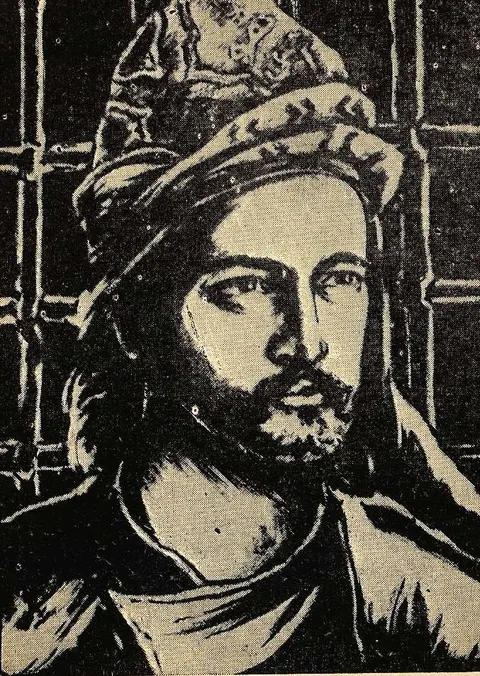
Shahab al-Din Suhrawardi was a Persian philosopher, born in the village of Suhraward in northwest Iran. He studied in Maragheh and Isfahan, then travelled through Anatolia and Syria. At 32 he finished his major work, The Philosophy of Illumination.
He was executed in Aleppo at around 37, accused of heresy. Two titles stayed with him: Shaykh al-Ishrāq, Master of Illumination, and al-Maqtūl, the one who was killed.
He saw himself as reviving a lost wisdom, and wove together:
- Ancient Persian wisdom and its Zoroastrian language of light
- Plato, Pythagoras and Hermes
- Avicenna, the great rationalist whose method he criticised
- Sufi mysticism and the inner journey
- Born
- 1154 Suhraward, Iran
- Major work
- 1186 Ḥikmat al-Ishrāq
- Died
- 1191 Aleppo, Syria
- Writings
- 50+ in Persian and Arabic
02Everything is light نور
“If there is anything in existence that does not need to be defined, it is light.”
Most philosophers start from abstractions like “being” or “substance”. Suhrawardi starts from something you can see. Light shows itself, and it shows everything else. You don't need a definition to know it; you only need to see it.
So he doesn't split the world into light and matter. Everything is light, at some degree of intensity. An angel is intense light; a stone is very faint light, what he called dark or “dusky” substance. Nothing new is added on the way down. Only the brightness changes.
And you are a light too. The “I” that is aware of itself, without needing to look in a mirror, is exactly what light is: something evident to itself. For Suhrawardi, whatever is present to itself is light.
03Two ways of knowing
The philosophers of his day held that real knowledge comes through definitions. Suhrawardi saw a problem: every definition is made of words that need their own definitions. Somewhere, something has to be known directly. He called that ground knowledge by presence.
- Intuitive, immediate
- Direct, unmediated encounter
- Self-evident, beyond definition
- Embodied and experiential
e.g.Feeling your own pain. Knowing that you exist. Nobody has to prove these to you.
- Rational, discursive
- Mediated by concepts and words
- Needs proofs and definitions
- Abstract, indirect, representational
e.g.Knowing the population of Isfahan. You hold an idea of the thing, not the thing.
He doesn't throw reasoning away. He puts it second. In one of his books he recounts a dream in which Aristotle tells him where knowledge begins: with yourself, and how you know yourself.
“In Suhrawardi's thought, presence is the effect of light, and light is the vehicle of presence.”
04Hierarchy of light
Picture a lamp in a dark room. Light is strongest at the source and fades with distance, yet it is the same light all the way. Suhrawardi's cosmos is ordered like this: one source, and everything else is its radiance, growing fainter as it descends.
- Light of LightsNūr al-Anwārنور الأنوارthe source
Pure light that depends on nothing. It shines without ever running out, and everything else is its radiance.
- Dominating Lightsal-Anwār al-Qāhiraانوار قاهرهangels · intellects
Great lights that receive from the source and pass light on, each one dimmer than the one before. Some are the archetypes of every species.
- Governing Lightsal-Anwār al-Mudabbiraانوار مدبّرهsouls
Lights that take charge of a body and steer it. The soul in you is one of these.
- Imaginal FormsʿĀlam al-Mithālعالم مثالsuspended images
Shapes and colours without matter: the images of dreams, visions and mirrors.
- Bodiesal-Barzakhبرزخmatter · the dark isthmus
Dark in itself. A body shows up only when light falls on it; on its own it is a barrier, a veil.
Each light loves the brighter light above it and shines on the dimmer light below. That pull upward and pouring downward is what keeps the whole cosmos in motion.
05The imaginal world عالم مثال
Between pure light and heavy matter, Suhrawardi placed a middle realm: a world of images that have shape and colour but no matter. Think of a face in a mirror. You can see it clearly, but you can't touch it, and it isn't inside the glass.
Crucially, he said these images are not just inside your head. They exist on their own, and a person can travel there in dreams and visions. In Persian he named it nā-kojā-ābād (ناکجاآباد), the land of Nowhere. In the twentieth century the French scholar Henri Corbin called it the mundus imaginalis, and warned against confusing it with the merely imaginary.
ESHRAQ is an attempt to explore how this imaginal world might take shape through computation and simulation.

06Soul and body
For Suhrawardi, each soul is a governing light that has come down into a body. It runs the body, but it is not the body. When it leaves, the body stays behind, unlit.
Aware of itself. Runs the body the way software runs on hardware.
Not aware of itself. Lit only while the soul governs it; dark again when it leaves.
His stories tell this as exile. In The Tale of the Western Exile, a traveller is imprisoned at the bottom of a well in a dark city of the West, and forgets where he comes from until a hoopoe arrives with a letter from home. The soul's task is to remember, and to turn back toward the light.
How ESHRAQ takes it further
You don't see your own soul in ESHRAQ. You bring it with you. When you take an agent, your soul becomes its governing light.
But you are not the only soul here. Wandering souls float through the world as glass orbs with metal horns, filled with glowing red air. Because a soul is airy, it doesn't stay sealed. If a wandering soul is present in the model you enter, it will find its way into your thoughts and actions. You don't choose this. It is a forced relationship, a co-presence.
01You arrive and govern an agent.
02A wandering soul is present in the same model.
03It blends with your soul, and may even take over.
From then on, your thoughts and your agent's behaviour can be coloured by another soul. Sometimes you won't be sure whose idea it was.
“Is it me thinking this, or the soul beside me?”
07Modules and spells
If everything is light at different intensities, then even the building blocks of a world are light, condensed until it holds a shape. In ESHRAQ these blocks are modules.
A building block, like a LEGO brick, made from light. On its own it is still, the way Suhrawardi's bodies are dark until light falls on them.
Made of lightning. A function you apply to an agent or a module that changes how it behaves.
Modules can carry spells. Nothing happens until an agent touches one. Then the spell fires and the module comes alive.
Why lightning? Suhrawardi describes the first lights a seeker meets as sudden flashes: brief, bright, and gone. A spell is light in that form, a quick strike that sets still things in motion.
One spell on one module is simple. But many agents, modules and spells acting on each other start to build depth, complexity and emergent behaviours nobody designed. ESHRAQ encourages this. Like light itself, a world here is never meant to stand still. It is always flowing.
08Models and canvases
Put modules together, add agents and spells, and set rules between them, and you have a model: a level in ESHRAQ. Every model is placed on a canvas: the surroundings it sits in, like a desert, an ocean or a city street. The canvas sets the ground underfoot, the light and the weather, so the same model can feel completely different from one canvas to the next.
Models are not fantasy. The Ziggurat of Ur, Amsterdam and most others start from something real: a place, a structure, a phenomenon. Making a model means distilling that subject from the physical world into the imaginal one, keeping what matters and letting the rest fall away.
The biologist Robert Rosen drew this as a loop between a natural system and a formal one. ESHRAQ follows the same loop, with play in the middle:
You step into the model, become present in it, and play. What happens there can be carried back as a new way of seeing the real thing. Not knowledge by representation, but knowledge by presence.
“…these intermediate realms illuminate each other, inviting this transcendent space into a slightly fuller presence in our world.”
09Further reading
- Light and PresenceESHRAQ.io · 2026
- Bridging Intermediate RealmsESHRAQ.io · Devlog n.5 · 2025
- SuhrawardiStanford Encyclopedia of Philosophy
- The Philosophy of IlluminationSuhrawardi · trans. J. Walbridge & H. Ziai · 1999
- Mundus Imaginalis, or the Imaginary and the ImaginalHenri Corbin · 1964
- Knowledge by PresenceMehdi Ha'iri Yazdi · 1992
- Anticipatory SystemsRobert Rosen · 1985 · the modelling relation